Agenda, Minutes or Report: Which Record Answers Your Question?
Agenda, minutes or report: identify the source of a public claim, distinguish draft from approved records, and cite only what the document shows.
Agenda, minutes or report: which record should you open when a public claim sounds too certain? Start with the claim itself. An agenda can show what officials planned to address, minutes can record what happened, and a report can explain the material prepared for an item. The useful question is not which document matters most, but which one can support the sentence you want to write.
Match the public claim to its documentary source
Records differ not just in detail, but in what they preserve. An agenda is a planning document. Minutes are an account of proceedings. A staff report or technical attachment presents material prepared for consideration. The distinction helps a reader check a statement without treating every document in a meeting packet as interchangeable evidence.
Use this quick test before relying on a record:
- Observation: The claim says an item was scheduled. If the agenda lists it, then describe it as scheduled; otherwise, check a revised agenda or the clerk’s meeting records.
- Observation: The claim says a body took an action. If the minutes or action record documents it, then report that recorded action; otherwise, do not infer an outcome from the agenda.
- Observation: The claim gives the exact terms of a decision. If an adopted resolution, ordinance, or contract states those terms, then cite that instrument; otherwise, qualify the wording and seek the final document.
- Observation: The claim explains why a proposal was recommended. If a report gives that reasoning, then attribute it to the report’s author; otherwise, look for another supporting document rather than assigning a rationale.
- Observation: The record is marked draft or unapproved. If that status appears, then identify it as a draft; otherwise, check the body’s approval practice before calling it final.
- Observation: Two documents show different versions or dates. If one is newer or has a different status, then compare those details before describing a conflict; otherwise, ask the clerk or records office which version is operative.
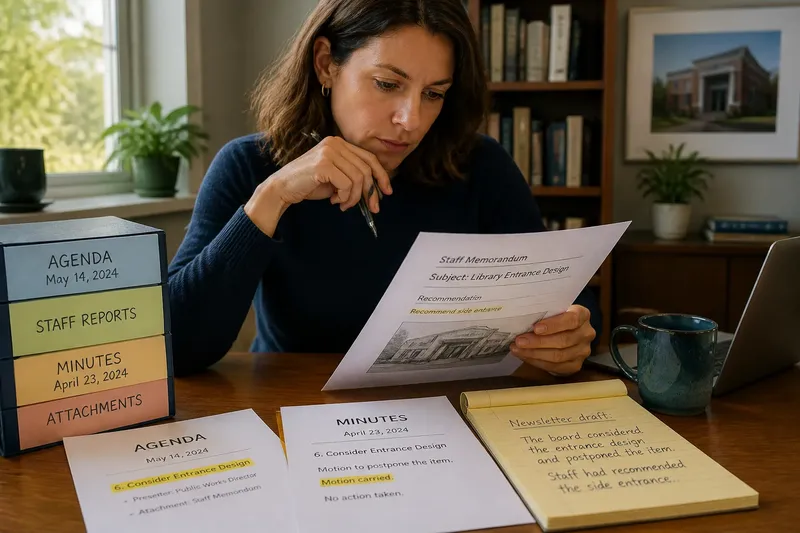
Imagine a resident is preparing a neighborhood newsletter from an invented packet about a proposed library entrance. The agenda lists “consider entrance design,” and a staff memorandum recommends a side entrance; the minutes later say the item was postponed. The careful newsletter sentence is that the board considered the item and postponed it, while staff had recommended the side entrance. It would be inaccurate to say the board approved that design.
An agenda documents planned business
An agenda can identify the meeting date, order of business, item titles, presenters, and attachments. It is often the best way to locate the materials officials were expected to discuss. Search the agenda packet for the item number or title, then note any linked files and whether the item appears under a consent agenda.
Compressed wording can sound conclusive. “Consider contract award” means the award was on the schedule; it does not establish that officials awarded the contract. An item may be withdrawn, postponed, handled in another order, or discussed without action. Describe what the agenda says, not what you assume happened afterward.
Minutes preserve a formal account of proceedings
Minutes commonly record attendance, motions, votes, and actions, but they are not necessarily a transcript. A brief entry such as “motion carried” may establish that a motion passed without recording each member’s position or the full discussion. Check for a roll-call vote, separate action sheet, recording, or transcript if those details matter.
Look for the minutes’ status. Draft, unapproved, and approved versions are not the same. A board’s rules and local practice determine how its records are labeled and approved, so ask the clerk or records office when the status remains unclear.
A report explains material prepared for consideration
A staff memorandum, fiscal note, consultant report, or technical attachment may describe options, provide analysis, or recommend a course of action. Read its title, author, date, and recommendation language. Those details help establish whose assessment the document contains and which version was prepared for the meeting.
Reports can be especially useful for understanding maps, cost assumptions, policy options, or technical terms that minutes omit. Keep the attribution attached: “the staff report recommended” is different from “the board decided.” If a later report revises an earlier attachment, compare dates and file labels rather than assuming both describe the same proposal.
Which record answers the question you have?
Was the item on the meeting agenda?
Open the agenda for the relevant meeting date and find the item title or number. It establishes what was scheduled, not whether officials reached or acted on it.
What action does the record show?
Check the minutes or official action record for that meeting. If you need exact policy or legal wording, look for the adopted resolution, ordinance, or other final instrument.
Who recommended the proposal?
Read the report or memorandum and note its author and date. Attribute its reasoning to that author unless a separate record establishes that the body adopted the same rationale.
What did a member say?
Minutes may summarize discussion without naming speakers. Check whether the body has a recording or transcript, and confirm that it covers the meeting and portion at issue.
Describe the record without stretching its meaning
When writing a public summary, choose verbs that match the source: an agenda listed an item, a report recommended an approach, and minutes recorded an action. If a final instrument supplies the exact terms, cite it for those terms. This keeps a short account clear while showing readers where its claims come from.
For agenda, minutes or report, the best starting point is the document closest to the claim you need to verify. Keep its date, status, author, and wording in view. Those small details can reveal whether a sentence describes a plan, an analysis, or an event that the public record actually documents.