How to Read a Public Notice and Find the Action It Requests
Learn how to read a public notice, spot the requested action and deadline, and use its attachments to prepare a focused response without guessing.
What does a public notice ask you to do before its deadline? To read a public notice accurately, locate the requested action, the relevant date, and any instructions tied to them. Then check the cited materials for details that affect your response.
Identify the notice’s purpose and requested action
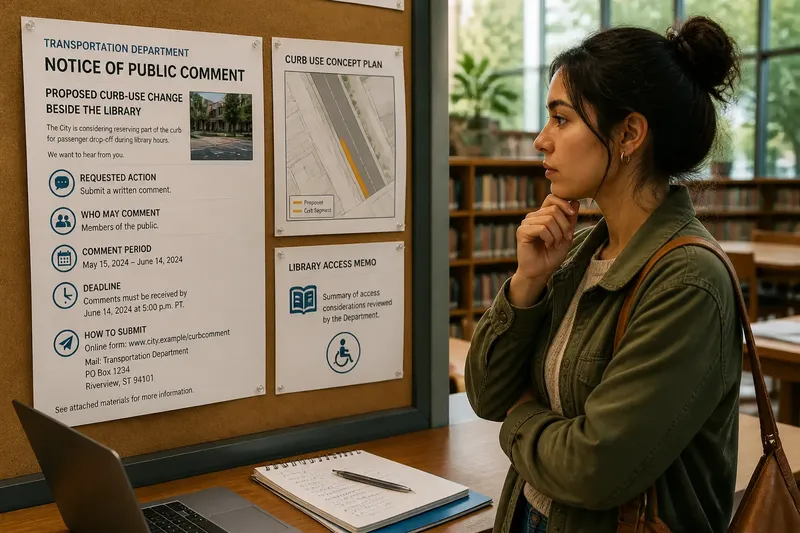
Imagine Maya finds a fictional city notice on a library bulletin board. Its heading says the Transportation Department is accepting comments on a proposed curb-use change beside the library. The opening paragraph says the city is considering reserving part of the curb for passenger drop-off during library hours.
The notice’s purpose is to invite comments about a proposal. Its requested action is to submit a written comment. Those are related, but not interchangeable: knowing the subject does not tell Maya what kind of response the notice accepts.
She scans for action words such as “submit,” “attend,” “register,” or “object,” then checks who may act and how. The notice invites comments from the public and lists an online form and a postal address. It does not ask readers to attend a meeting or sign a petition.
A quick reading note can keep the instructions clear:
- Observation: the notice says written comments are accepted. If the form and postal address are both listed, then choose either channel; otherwise, use the channel the notice specifies.
- Observation: the notice names the public as its audience. If it limits participation to a particular group, then check whether you meet that condition; otherwise, do not infer an unstated restriction.
- Observation: the notice says comments should identify the curb-use proposal. If it names a required subject or format, then follow that instruction; otherwise, keep the comment clearly tied to the proposal.
- Observation: the notice asks for comments, not meeting attendance. If a meeting is separately listed as optional, then decide whether to attend; otherwise, do not treat attendance as a required step.
- Observation: the notice gives an online form and postal address. If one channel is inaccessible or unavailable, then use the other listed channel; otherwise, select the one that suits your needs.
- Observation: the notice uses words such as “proposed” or “considering.” If the requested action concerns a proposal, then respond to that proposal; otherwise, check the wording carefully before describing the matter as pending or settled.
Read each date beside its instruction
A public notice may include a publication date, a meeting date, a comment-period opening date, and a submission deadline. Read the words next to each date instead of assuming they serve the same purpose.
Maya’s fictional notice says comments must be received by the deadline. That wording matters: posting a letter by that date may not meet an instruction requiring it to arrive. She checks the original city PDF for the deadline, any stated time zone, and the active submission link, then saves a copy for reference.
If a neighborhood email contains a cropped image, use it as a pointer rather than as the complete instruction. The issuing agency’s original notice is the better place to verify the exact wording and any attached forms.
Use attachments to sharpen questions, not invent answers
The fictional notice names a “Curb Use Concept Plan” and a “Library Access Memo.” Maya opens both. The plan marks the proposed curb segment; the memo describes access concerns the department says it considered.
She compares the plan with the notice’s phrase “part of the curb.” The drawing appears to mark a specific segment, but the available materials do not clearly show whether it overlaps with an accessible loading area. Maya can now ask a focused question about that location rather than claim the documents have settled the issue.
If a cited file is missing or a link fails, note the exact document title and ask the issuing office where to find it. A similar-sounding file is not necessarily the one the notice names. Keep separate notes for what the notice says, what an attachment depicts, and what remains unanswered.
What should you check before responding?
Does a notice tell me which response to send?
It tells you the permitted action and any stated requirements, such as a topic, form, or submission channel. It does not dictate your view; make your response address the matter described in the notice.
What should I do if the deadline wording is unclear?
Read the full instruction beside the date and check whether it says comments must be received, submitted, or mailed by then. If the wording still leaves doubt, contact the office named on the notice rather than relying on an assumption.
Can I quote an attachment in my comment?
Yes, if you identify the document and the point you mean. Distinguish what the attachment actually says or depicts from the question or concern you draw from it.
What if the notice or a linked file has changed?
Check the issuing agency’s current copy and note which version you used. If the deadline, link, or instructions differ, ask the responsible office which information applies.
Turn the instructions into a focused response
Say Maya’s fictional notice gives a closing date, accepts comments through an online form or by mail, and links to the plan and memo. After checking those details, she chooses the online form, identifies the curb-use proposal, and asks whether the marked segment overlaps with the accessible loading area. She also asks where the department explains how it selected that segment. Her response follows the notice’s instructions while making clear which point the cited materials leave open.
Before submitting, she checks that the comment names the proposal, uses an accepted channel, and addresses the question she intends to raise. That is a practical way to read a public notice: follow its stated instructions, use its attachments precisely, and make unresolved questions explicit without turning them into claims.